
Beautiful Plants For Your Interior
Price range: $5.00 through $45.00
I raise Delaware chickens at Pure Greenland Farm for customers looking for a productive dual-purpose bird that can provide both eggs and meat. Delaware chickens were developed in the United States in the 1940s from a breeding program involving Barred Plymouth Rock roosters and New Hampshire hens. The breed was originally developed with fast growth, rapid feathering and broiler production in mind.
Today, I value Delaware chickens because they remain useful for backyard flocks, homesteads and small farms. They have a substantial body, attractive white plumage with black barring around the neck and tail, useful egg production and good growth characteristics.
At Pure Greenland Farm, I raise Delaware chicks, pullets, hens and roosters according to availability, with attention to nutrition, clean housing, fresh water and good flock management.
Delaware chicks are a good choice for customers who want to establish their flock from the beginning.
I raise young Delaware chickens with appropriate chick starter feed, clean water, warmth and secure brooder housing. Delaware chicks are known for relatively rapid growth and fast feathering, which are characteristics that contributed to the breed’s historical use in broiler production.
Before bringing Delaware chicks home, I recommend preparing:
Delaware pullets are young female chickens being raised toward maturity and egg production.
I provide Delaware pullets for customers who want to skip the earliest chick-brooding stage and begin with more developed birds. Pullets can become productive laying hens and can also be incorporated into breeding programs once mature.
Their eventual egg production depends on genetics, age, nutrition, health, daylight and management.
Mature Delaware hens can provide both household eggs and breeding value.
The Livestock Conservancy reports that Delaware hens can produce approximately 150–200 large to jumbo brown eggs per year, with individual production varying according to genetics and management.
I provide my laying hens with a balanced poultry diet, clean water, appropriate nesting areas, dry bedding and secure housing.
For customers looking for a practical farm chicken that can provide both eggs and meat, Delaware hens can be a useful addition to a well-managed flock.
I raise Delaware roosters for customers who want to establish or expand a Delaware breeding flock.
Delaware males develop a broad, deep body and can contribute to breeding programs focused on maintaining the breed’s characteristic color pattern, body structure and production qualities.
The current Livestock Conservancy breed chart lists approximately 8.5 pounds for mature males and 6.5 pounds for mature females.
When keeping a rooster with hens, I recommend providing adequate space and selecting a suitable flock ratio based on the birds and breeding goals.
I raise Delaware breeding stock for customers who want to produce their own Delaware chicks and maintain a dedicated breeding flock.
A Delaware breeding program can include:
When selecting breeding birds, I pay attention to body structure, feather pattern, development, health, vigor and overall suitability for the customer’s breeding goals.
Delaware hens lay brown eggs that can range from large to jumbo in size. The Livestock Conservancy identifies eggs as one of the breed’s primary uses.
If you are purchasing Delaware hatching eggs, proper egg collection, handling, storage and incubation are important. Hatch rates can vary depending on fertility, breeder condition, storage time, temperature, humidity and incubator management.
I recommend having your incubator properly prepared before beginning a Delaware hatching-egg project.
I feed Delaware chickens according to their age and purpose.
Because Delaware chickens can grow quickly, I focus on balanced nutrition rather than excessive treats or uncontrolled high-calorie feeding.
I keep Delaware chickens in clean, dry and secure housing with adequate ventilation.
A suitable Delaware chicken coop should provide:
Delaware chickens can also be managed in a fenced run or controlled free-range environment.
Yes. Delaware chickens can be managed in free-range or pastured systems when the environment is appropriate.
The Livestock Conservancy describes Delaware chickens as curious birds that enjoy exploring and notes that they prefer being out and about, although they can also tolerate confinement when provided with suitable activity.
I recommend secure fencing and predator protection, particularly when Delaware chickens are allowed to range during the day.
Delaware chickens can fit well into backyard farms and homesteads because they combine useful egg production with meat characteristics.
I particularly value them for customers who want a bird that can contribute to more than one part of a small-farm operation.
A Delaware flock can provide:
Delaware chickens were specifically developed with broiler production in mind, which is an important part of their history. Their rapid growth, fast feathering and broad body contributed to their original commercial usefulness.
The breed was once widely used for broiler production in the Delmarva region before commercial Cornish-Plymouth Rock crosses became dominant.
For today’s small farms and homesteads, I consider Delaware chickens a useful traditional dual-purpose option for customers who want both meat and eggs.
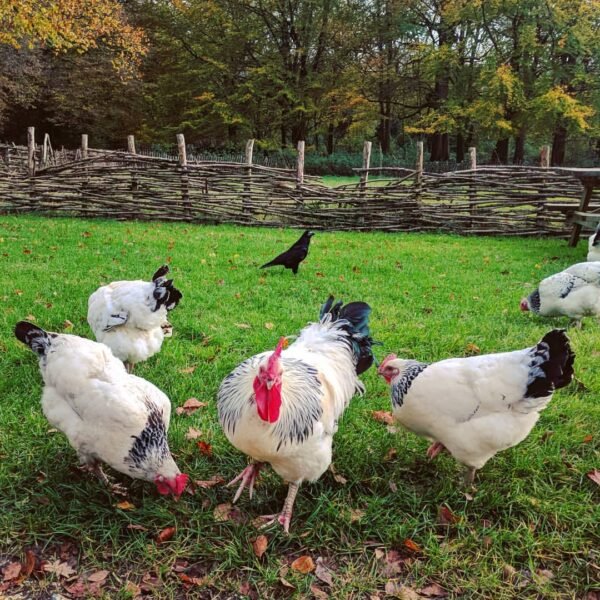
One of the easiest ways to recognize a Delaware chicken is its predominantly white body with contrasting black barring.
Delaware chickens typically have:
The Livestock Conservancy describes the body as robust and deep, with an inverted-triangle appearance from the side.
Delaware roosters are larger and heavier than Delaware hens.
Current breed references list approximate mature weights of:
Hens are particularly valuable for eggs and breeding, while roosters are important for maintaining breeding programs and producing offspring.
Delaware hens can be useful egg producers. The Livestock Conservancy’s current breed chart lists approximately 150–200 eggs per year, with large-to-jumbo brown eggs.
Actual production can vary depending on:
I therefore recommend viewing breed figures as useful reference ranges rather than guarantees for every individual hen.
Yes. Meat production is one of the defining characteristics of the Delaware breed.
The breed was developed specifically for rapid broiler growth and was historically used extensively in commercial broiler production. The Livestock Conservancy describes Delaware chickens as fast-growing and suitable for meat at different ages.
This history is one reason I continue to raise Delaware chickens for customers who want a traditional dual-purpose farm bird.
Delaware chickens can be suitable for beginner chicken keepers. The Livestock Conservancy’s current breed chart lists Delaware as suitable for novice keepers and describes the temperament as docile.
As with any breed, individual birds can differ. Good housing, proper nutrition, regular observation and responsible flock management are important for new and experienced poultry keepers.
Delaware chickens are generally known for a gentle disposition with people.
The Livestock Conservancy describes them as calm and friendly and notes that they can be assertive with other chickens without generally being bullies.
Individual temperament still varies between birds, so I pay attention to behavior when selecting birds for breeding or mixed backyard flocks.
Delaware hens are not generally considered strongly broody. The Livestock Conservancy notes that broodiness is not generally a characteristic of the breed.
If your primary goal is to hatch Delaware eggs naturally, an incubator or a broody hen from another suitable breed may be useful.
Delaware chickens can be managed in both hot and cold climates when appropriate housing and flock care are provided. The current Livestock Conservancy breed chart specifically lists the breed as doing well in both hot and cold climates.
During hot weather, I provide:
Delaware chickens can also be maintained in colder conditions when their housing is dry, secure and properly ventilated.
I focus on keeping bedding dry, preventing direct drafts at bird level and providing reliable access to unfrozen drinking water where necessary.
I consider Delaware chickens particularly useful for homesteaders who want a traditional dual-purpose flock.
A Delaware flock can support:
Their relatively fast growth and useful egg production make them versatile farm birds.
Both Delaware and New Hampshire Red chickens have strong connections to the development of American meat and egg poultry.
Delaware chickens were developed from a breeding program involving Barred Plymouth Rock roosters and New Hampshire hens, while New Hampshire Red chickens themselves were developed from selected Rhode Island Red lines.
Delaware chickens are easily recognized by their predominantly white plumage with black barring, while New Hampshire Reds have rich red plumage.
Both are dual-purpose breeds, but individual breeding lines can differ in growth, laying performance, temperament and body type.
Delaware chickens and Plymouth Rocks share an important historical connection because Barred Plymouth Rock males were used in the development of the Delaware breed.
The most obvious difference is appearance: Delaware chickens are primarily white with black barring on the neck, wings and tail, while Barred Plymouth Rocks have an overall barred black-and-white pattern.
Both can be useful for backyard and farm production, with Delaware being particularly associated with rapid growth and broiler development.
I raise Delaware chickens because they combine a fascinating American poultry history with practical farm characteristics.
I appreciate their rapid growth, fast feathering, substantial body, useful brown eggs and generally manageable temperament. They are also a heritage breed that has experienced a major decline from its former commercial importance, making responsible breeding and preservation valuable.
The Livestock Conservancy currently classifies Delaware as Recovering on its Conservation Priority List.
If you are looking for Delaware chickens for sale, Delaware chicks for sale, Delaware pullets, Delaware laying hens, Delaware roosters, Delaware breeding pairs, Delaware breeding stock or Delaware hatching eggs, contact Pure Greenland Farm to ask about current availability.
Availability can vary according to age, season, breeding schedules and flock numbers.
I can help you identify the appropriate Delaware birds for your backyard flock, homestead, breeding program, egg production or small-farm meat operation.
Delaware chickens are an American dual-purpose breed developed in the 1940s from a breeding program involving Barred Plymouth Rocks and New Hampshire chickens. They were originally developed for fast-growing broiler production but remain useful today for eggs, meat, breeding, homesteads and small farms.
The current Livestock Conservancy breed chart lists Delaware chickens at approximately 8.5 pounds for males and 6.5 pounds for females, with large-to-jumbo brown eggs and approximately 150–200 eggs per year under suitable conditions.
At Pure Greenland Farm, I raise Delaware chicks, pullets, hens, roosters and breeding stock for customers looking for farm-raised dual-purpose chickens.
If you are searching for Delaware chickens for sale, Delaware chicks for sale, Delaware hens, Delaware roosters, Delaware breeding pairs, Delaware hatching eggs or Delaware farm chickens, I welcome you to contact Pure Greenland Farm and ask about current availability.
| AGE | CHICKS, PULLETS, LAYING HENS, ROOSTERS |
|---|
Reviews
There are no reviews yet.