Beautiful Plants For Your Interior
If you are searching for turkey breeds, trying to decide which turkey is right for your farm, researching heritage turkey breeds, looking for turkey poults for sale, or simply wondering how the different types of turkeys compare, there is much more to consider than color and body size.
A turkey can be raised for meat, breeding, eggs, exhibition, conservation, pasture production, homesteading, or simply because these remarkable birds belong on a productive farm.
At Pure Greenland Farm, we believe choosing livestock should begin with understanding the animal rather than simply choosing the first breed available. A turkey that works extremely well for a large commercial meat operation may not be the right bird for a family homestead. Likewise, a beautiful heritage turkey may be an excellent choice for natural breeding and pasture management but require more time to reach market size than a commercial strain.
That distinction matters.
The modern turkey industry has developed highly specialized birds for rapid growth and efficient meat production. At the same time, farmers, homesteaders and conservation breeders continue to maintain traditional turkey varieties whose characteristics include natural mating, foraging ability, longer productive lives and slower growth. The Livestock Conservancy defines Heritage Turkeys around those traditional characteristics rather than simply feather color or appearance.
If you are looking for farm animals, poultry and agricultural products, visit Pure Greenland Farm.
This guide brings together the major turkey breeds and varieties, explains what makes each one different, and provides practical information to help you decide what type of turkey fits your goals.
Before comparing breeds, it is important to understand the terminology.
People commonly use the words breed, variety, strain and type interchangeably when discussing turkeys. Technically, they can mean different things.
A turkey variety may be distinguished primarily by its appearance, such as feather color and pattern, while a commercial strain may have been selected heavily for production traits such as growth rate, breast development and feed efficiency.
This is particularly important when comparing heritage turkeys and commercial turkeys.
The Livestock Conservancy explains that Heritage Turkeys must be naturally mating, have a long productive outdoor lifespan and grow at a slow-to-moderate rate. Heritage birds generally reach marketable weight at around 28 weeks, although individual birds and varieties differ.
Modern commercial broad-breasted turkeys were developed primarily around efficient meat production. Their extreme breast development can prevent normal mating, meaning commercial breeding programs commonly use artificial insemination.
That creates two very different management systems.
Heritage turkey production often emphasizes:
Commercial turkey production generally emphasizes:
Neither category should automatically be treated as interchangeable with the other.
Some of the major turkey varieties and types you will encounter include:
The eight varieties recognized in the American Poultry Association’s Standard of Perfection and identified by The Livestock Conservancy as Heritage Turkeys are Black, Bronze, Narragansett, White Holland, Slate, Bourbon Red, Beltsville Small White and Royal Palm. Additional naturally mating varieties are also recognized within heritage conservation, including Jersey Buff and Midget White.
Now let’s look at them individually.
The Standard Bronze turkey is one of the most historically important American turkey varieties.
Bronze turkeys have striking metallic-looking plumage with dark and bronze coloration that gives the variety its name.
Historically, Bronze was one of the dominant turkey varieties in American agriculture. The Livestock Conservancy describes the Bronze as the most popular turkey variety for much of American history.
A major distinction must be made between Standard Bronze and today’s Broad Breasted Bronze.
A naturally mating Standard Bronze belongs to the heritage category, while modern broad-breasted commercial birds were selected for production characteristics.
Standard Bronze turkeys are known for:
They generally need considerably more room than someone might expect from a chicken flock.
A common mistake for new turkey owners is providing a small chicken-style enclosure without considering how quickly turkeys grow and how much space mature birds require.
For a farm environment, pasture access combined with secure night housing can be particularly useful.
The Broad Breasted Bronze is a commercial meat-production type rather than the same thing as a heritage Standard Bronze.
It was developed through selection for increased body size and breast meat.
Modern commercial broad-breasted birds are highly specialized meat animals.
Their enormous breast development can make natural mating difficult or impossible, which is why commercial breeding programs rely on artificial insemination.
This turkey type can be attractive to farmers whose primary objective is meat production and predictable growth.
However, someone searching specifically for a heritage turkey breed should not assume that every turkey labeled Bronze qualifies as a Heritage Turkey.
This is one of the most important distinctions when purchasing turkey poults.
The Broad Breasted White turkey is probably the type most people recognize from supermarkets.
The development of white-feathered commercial turkeys was strongly influenced by the retail market because white feathers leave a cleaner-looking carcass after processing compared with dark-feathered birds.
The modern Broad Breasted White has been selected primarily for:
The modern commercial turkey is therefore very different from a traditional heritage turkey.
If your search is “best turkey breed for meat production,” Broad Breasted White is likely to appear frequently because of its commercial importance.
If your search is “best turkey breed for natural breeding,” however, you should investigate heritage varieties instead.
The Narragansett turkey is one of America’s classic heritage turkey varieties.
It has a distinctive combination of black, gray, white and bronze coloration and is historically associated with the northeastern United States.
Narragansett turkeys are valued for:
The variety remains on The Livestock Conservancy’s Conservation Priority List.
For farmers interested in maintaining breeding stock, Narragansetts offer something that highly specialized commercial turkeys generally do not: a traditional naturally mating production model.
The Bourbon Red turkey is one of the most popular heritage turkey breeds among small farms and homesteaders.
Its rich reddish-brown plumage makes it particularly recognizable.
Bourbon Reds were developed in the United States and have become closely associated with heritage turkey production.
They are valued for:
The Livestock Conservancy currently lists Bourbon Red as a Watch-status turkey variety.
For someone searching “best heritage turkey breed for a small farm,” Bourbon Red is a variety worth researching.
However, the best breed depends on your climate, available pasture, housing, predator pressure, breeding goals and intended market.
The White Holland turkey is another historic American heritage variety.
It is characterized by white plumage and has traditionally been valued as a meat bird.
White Holland turkeys are active foragers and can work well in pasture-based systems.
The Livestock Conservancy currently identifies White Holland as Threatened on its Conservation Priority List.
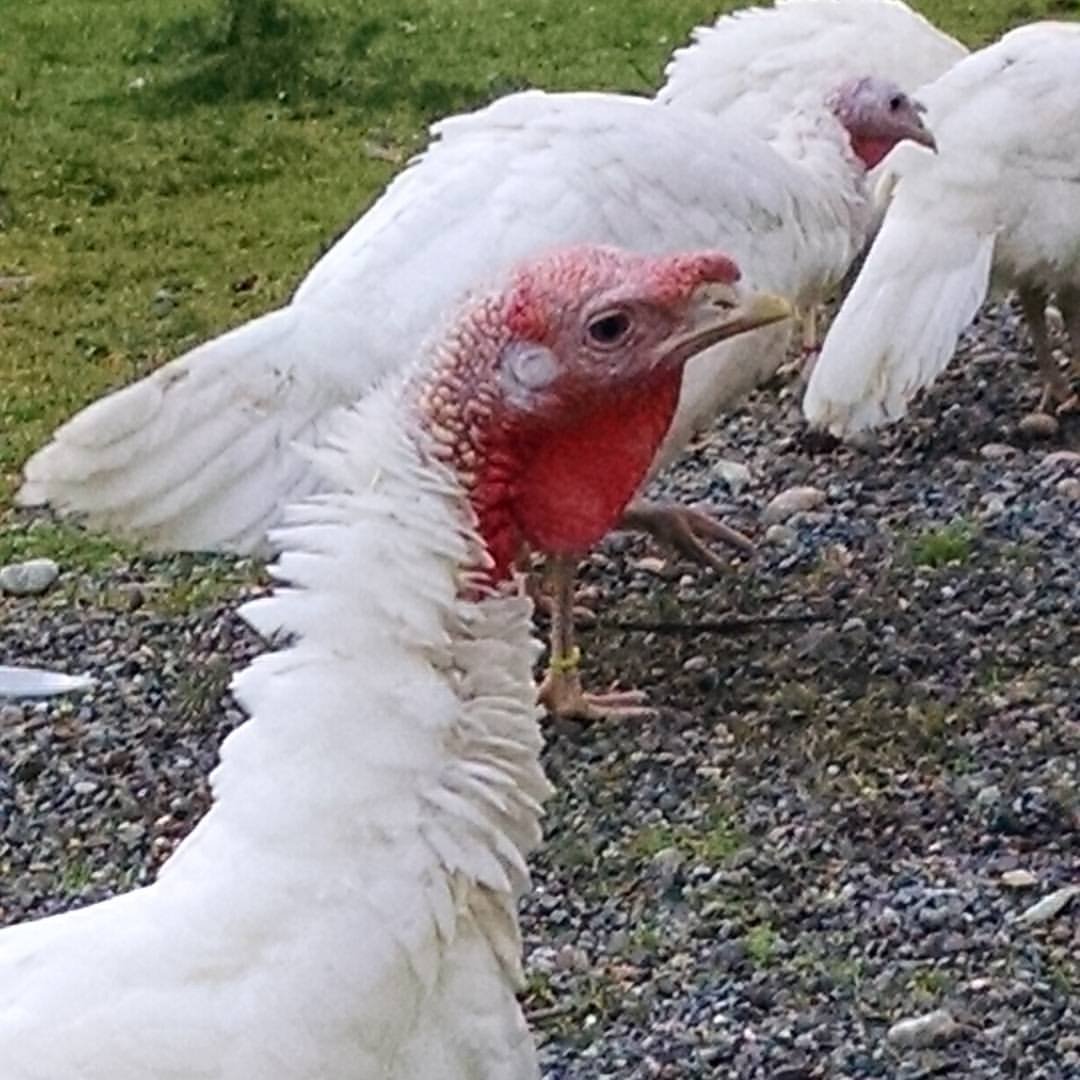
An important purchasing lesson is worth emphasizing here: don’t assume that a white turkey is automatically a White Holland.
Commercial Broad Breasted White turkeys and heritage White Holland turkeys are different.
When buying breeding stock, ask the seller about:
The Livestock Conservancy specifically advises buyers to obtain White Holland stock from reputable breeders to avoid confusion with Broad Breasted White crosses.
The Black turkey, sometimes called the Black or Spanish Black variety, is an important historic turkey type.
It is one of the varieties included among the traditional APA-standard heritage turkeys.
Black turkeys are particularly interesting to conservation-minded farmers because maintaining traditional varieties helps preserve genetic diversity within domestic poultry.
The Livestock Conservancy currently lists Black turkey as a Watch variety.
For someone interested in rare turkey breeds, heritage poultry, traditional farming or turkey conservation, the Black turkey deserves consideration.
The Royal Palm turkey is immediately recognizable.
It is predominantly white with contrasting black markings and is often considered one of the most visually striking heritage turkey varieties.
Royal Palms are generally smaller than the largest meat-oriented turkey varieties and are frequently kept for:
Because of their appearance, searches such as “beautiful turkey breeds,” “ornamental turkey breeds,” and “best backyard turkey breeds” often lead people toward Royal Palms.
They can also be useful for farmers who want a visually distinctive bird rather than simply maximizing carcass weight.
The Slate turkey, also called Blue Slate or Lavender in some contexts, is famous for its slate-gray coloration.
The Livestock Conservancy lists Slate as a Watch variety and describes it as being used for meat and exhibition.
Slate coloration can vary, and breeding for consistent coloration can present challenges.
The variety is interesting to both poultry exhibitors and farmers who want an unusual heritage turkey.
Its appearance makes it especially attractive for:
The Beltsville Small White is particularly interesting because it was developed through a U.S. Department of Agriculture breeding program at Beltsville, Maryland.
Historical USDA information explains that it was developed from multiple turkey varieties and selected for a smaller size suitable for retail demand.
Compared with very large turkey types, the Beltsville Small White provides an interesting option for households and farmers who do not need an enormous bird.
The Livestock Conservancy currently lists it as Threatened.
This makes it relevant to both small-scale poultry production and genetic conservation.
The Jersey Buff turkey is a historic variety recognized for its buff-colored plumage.
It originated in the Mid-Atlantic region and was historically used in the development of other turkey varieties, including Bourbon Red.
It is a distinct variety but is not currently recognized in the APA Standard of Perfection, which places it among other varieties for classification purposes.
For farmers interested in rare heritage turkey breeds, Jersey Buff is an important name to know.
The Midget White turkey was developed as a smaller turkey suitable for people who wanted a more manageable bird.
Its smaller size can make it interesting for:
The Midget White is among the distinct non-APA varieties recognized within The Livestock Conservancy’s conservation framework.
For someone searching “small turkey breeds” or “best turkey breed for a small farm,” this is one of the varieties worth investigating.
The Chocolate turkey is another distinct heritage color variety.
As the name suggests, its plumage has a chocolate-brown appearance.
It is not one of the eight APA-standard heritage varieties but is included among other distinct turkey varieties recognized by The Livestock Conservancy’s conservation program.
This type may appeal particularly to poultry breeders and people maintaining rare or unusual turkey genetics.
The Lavender turkey is known for its unusual pale gray or lavender coloration.
It belongs to the broader group of distinct color varieties maintained by heritage poultry breeders.
For people interested in:
Lavender turkeys can be an interesting addition.
This is perhaps the most important comparison in the entire article.
| Feature | Heritage Turkey | Commercial Broad-Breasted Turkey |
|---|---|---|
| Natural mating | Generally yes | Generally no |
| Growth | Slow to moderate | Fast |
| Foraging | Strong | More limited |
| Outdoor production | Well suited | Requires careful management |
| Productive lifespan | Longer | Short production cycle |
| Body type | More traditional | Extremely broad breast |
| Main purpose | Meat, breeding, conservation | Meat |
| Small farm suitability | Often strong | Depends on facilities |
| Breeding flock | Practical | Specialized |
| Genetic conservation | Important | Not usually the primary purpose |
The Livestock Conservancy states that heritage turkeys have long productive outdoor lifespans and are naturally mating, whereas modern broad-breasted commercial varieties were selected around intensive production efficiency.
There is no single turkey breed that is automatically best for every farm.
Instead, ask:
Best for what?
The best turkey breed for meat production may not be the best turkey breed for natural breeding.
The best turkey breed for a homestead may not be the best turkey for a commercial processor.
The best turkey breed for exhibition may not be the best turkey for maximum meat yield.
Your decision should consider:
Are you raising turkeys for:
Turkeys need more room than chickens.
Crowding increases management challenges and can contribute to hygiene and behavioral problems.
Your local weather should influence your choice of housing, shelter, ventilation, water management and pasture strategy.
Young poults are vulnerable.
Foxes, raccoons, dogs, birds of prey and other predators can create significant losses if the farm is not properly secured.
Turkey growth requires adequate nutrition.
Choosing a breed without calculating feed availability and costs can turn an apparently attractive production plan into an expensive one.
A farmer selling Thanksgiving birds may have different requirements from someone selling breeding stock.
If your customers specifically want heritage turkeys, breed identity and breeding records can become much more important.
Raising healthy turkeys starts before the poults arrive.
A professional turkey management program should consider:
Young poults need special attention during their early development.
The first days and weeks are not the time to assume that birds will simply “take care of themselves.”
Check poults frequently.
Look at:
Real farm management is often about noticing small changes before they become large problems.
A turkey’s nutritional requirements change as it grows.
Young poults require a nutritionally appropriate starter ration, while older birds transition through diets suitable for their growth stage.
Good management should not be based simply on feeding turkeys whatever poultry feed happens to be available.
A turkey needs appropriate nutrition for:
Pasture can provide opportunities for natural foraging, but pasture should complement—not automatically replace—a properly formulated diet.
This is particularly important when raising rapidly growing meat birds.
Heritage turkeys are often active foragers and can make excellent use of outdoor space. The Livestock Conservancy specifically describes heritage varieties as suitable for pastured production.
Good turkey housing does not need to be unnecessarily complicated, but it needs to be functional.
A suitable turkey shelter should provide:
Ventilation deserves particular attention.
A building can be warm and still have poor air quality.
Moisture buildup, ammonia and dirty bedding create an environment that is less suitable for healthy poultry.
Good ventilation should remove moisture and stale air without creating dangerous drafts directly on young birds.
Sometimes, yes, but careful management is important.
Turkeys and chickens can share some farm environments, but they are not identical species from a management perspective.
One major concern is disease transmission.
Blackhead disease, caused by Histomonas meleagridis, is particularly important in turkey management because chickens can act as carriers without showing the same severity of disease seen in turkeys.
For this reason, experienced poultry keepers should carefully consider whether turkeys and chickens should share the same ground, housing and management system.
Biosecurity is not something to think about only after an illness appears.
It should be part of farm planning from the beginning.
One of the major attractions of heritage turkeys is their ability to reproduce naturally.
This is completely different from commercial broad-breasted production.
Heritage breeding involves selecting healthy breeding stock rather than simply choosing the largest birds.
Important selection characteristics can include:
The Livestock Conservancy provides dedicated guidance for breeders on selecting breeding animals and maintaining breed characteristics.
A farm interested in preserving heritage genetics should keep accurate records.
Record:
Over several seasons, these records become extremely valuable.
Yes.
Female turkeys, called hens, lay eggs.
Turkey eggs are larger than chicken eggs and commonly have pale cream to medium-brown coloration with spotting. The Livestock Conservancy lists large, spotted eggs as characteristic across several heritage turkey varieties.
However, turkeys should not generally be viewed as an egg-production replacement for chickens.
The production goals are different.
If your primary objective is egg production, chickens, ducks or quail may be more appropriate.
If your objective is meat, breeding, heritage conservation or a mixed farm system, turkeys can provide a valuable role.
If you are searching online for turkey poults for sale, don’t make your decision based solely on price.
Ask the breeder or farm:
What breed are the poults?
Are they heritage or commercial?
Can the parent stock reproduce naturally?
What is the expected mature size?
What are the birds being fed?
How old are the poults?
Have they been properly managed before sale?
What is the breeder’s flock history?
For heritage birds, ask particularly about the parent stock.
A turkey sold as “Bronze,” for example, could refer to very different production types.
The same principle applies to White Holland versus Broad Breasted White.
Good purchasing decisions begin with accurate identification.
If your primary goal is meat production, you should consider growth rate, mature size, breast development, feed cost, processing requirements and customer preferences.
Commercial producers often select broad-breasted strains because they have been developed specifically for meat efficiency.
Heritage producers may instead choose:
The advantage of heritage production is not necessarily maximum speed.
It is a different production model.
Heritage birds offer characteristics that can be especially useful to farmers who want natural reproduction, pasture access, traditional varieties and a longer-term breeding flock.
Small farms often benefit from choosing birds according to available infrastructure rather than simply selecting the largest turkey.
Potential considerations include:
The right choice ultimately depends on your production objectives.
Homesteaders often look for animals that provide multiple benefits.
For turkeys, those benefits may include:
Heritage turkeys can be particularly attractive because their natural mating ability means a homesteader can maintain a breeding flock rather than continuously purchasing commercial poults.
That does not mean heritage turkeys are maintenance-free.
They still require:
A healthy turkey program starts with prevention.
Do not wait until birds are sick before thinking about biosecurity.
Good practices include:
If you notice unusual mortality, severe respiratory signs, neurological signs, dramatic reductions in feeding or drinking, or other serious abnormalities, contact a qualified veterinarian or appropriate animal-health authority.
Farm experience is valuable, but experience should complement professional veterinary guidance rather than replace it.
Turkey size varies dramatically.
For example, The Livestock Conservancy’s current breed information lists mature Standard Bronze males at up to roughly 35–38 pounds and females around 18–22 pounds, while Slate and White Holland have their own characteristic size ranges.
Commercial strains can be much more heavily selected for meat production.
This is why “How big does a turkey get?” cannot be answered with one number.
Breed, sex, genetics, feeding, age and production system all matter.
Heritage turkeys can have considerably longer productive lives than commercial meat turkeys.
The Livestock Conservancy’s definition specifies a long productive outdoor lifespan, with breeding hens commonly productive for approximately five to seven years and toms for approximately three to five years.
This is one of the most important differences between heritage and industrial production.
A commercial meat turkey is generally managed around a production schedule.
A heritage breeding bird is an ongoing farm asset.
For some farmers, yes—but the answer depends on the business model.
Heritage turkeys can provide opportunities for:
However, heritage turkeys grow more slowly than modern commercial birds.
That means the farmer needs to understand the economics.
Feed, land, housing, labor, processing and mortality all affect profitability.
A farmer should calculate the entire production cycle rather than focusing only on the selling price.
Successful turkey farming is a process.
Determine:
Young poults need careful temperature, nutrition and hydration management.
As birds grow, space requirements increase.
Heritage varieties can make excellent use of outdoor areas when appropriately managed.
At this point, your management decisions depend heavily on whether birds are intended for breeding or meat.
Potential markets include:
Use your goal as the starting point.
If you want commercial meat production:
Research Broad Breasted White and other commercial strains.
If you want a traditional bronze turkey:
Research Standard Bronze.
If you want a popular heritage meat variety:
Research Bourbon Red or Narragansett.
If you want a white heritage turkey:
Research White Holland.
If you want a smaller heritage turkey:
Research Beltsville Small White or Midget White.
If you want an ornamental heritage bird:
Research Royal Palm.
If you want unusual coloration:
Research Slate, Lavender or Chocolate.
If you want a conservation-focused flock:
Investigate heritage varieties and their current conservation status.
The Livestock Conservancy’s 2026 Conservation Priority List currently places Beltsville Small White and White Holland in the Threatened category and Black, Bourbon Red, Royal Palm, Slate, Standard Bronze and Narragansett in the Watch category.
The discussion about turkey breeds is not only about meat.
It is also about agricultural biodiversity.
When farmers maintain different turkey varieties, they preserve genetic characteristics that may become increasingly valuable in future farming systems.
Traditional livestock breeds may carry traits related to:
The Livestock Conservancy describes heritage breeds as genetic resources important to the future of food and agriculture.
That makes a heritage turkey flock more than a collection of birds.
It can also be a living agricultural resource.
Commonly discussed varieties include Bourbon Red, Narragansett, Royal Palm, Standard Bronze, White Holland, Black, Slate and Beltsville Small White. Modern commercial production is dominated by broad-breasted types.
The answer depends on whether you want rapid commercial production or heritage/pasture production. Broad-breasted commercial strains are designed for meat efficiency, while heritage varieties offer a different production model.
There is no universally best heritage variety. Bourbon Red, Narragansett, Standard Bronze, White Holland, Black, Slate, Royal Palm and Beltsville Small White all have different characteristics.
Size depends on the variety, sex and strain. Large commercial broad-breasted turkeys have been selected heavily for meat production, while some heritage varieties also reach substantial mature weights.
Midget White is one of the well-known smaller heritage turkey varieties. Beltsville Small White is another smaller traditional variety.
Yes. Natural mating is one of the defining characteristics of Heritage Turkeys under The Livestock Conservancy’s definition.
Modern broad-breasted commercial turkeys generally have body conformations that make natural mating difficult, so commercial breeding programs use artificial insemination.
Turkey poults require an appropriate nutritionally formulated starter feed and constant access to clean drinking water. Their nutritional requirements change as they grow.
Heritage turkeys are particularly well suited to pasture-based production when they receive suitable nutrition, shelter, water and predator protection.
Yes. Turkey hens lay large eggs, commonly pale cream to medium brown with spotting.
Yes, turkey eggs can be eaten. They are larger than chicken eggs and are generally less common in retail markets because turkeys are primarily raised for meat and breeding rather than commercial egg production.
Heritage turkeys generally grow more slowly than modern commercial strains. The Livestock Conservancy notes that Heritage Turkeys reach marketable weight at about 28 weeks, although individual birds vary.
Royal Palms can be raised for meat, but their smaller size and ornamental/exhibition appeal often make them more attractive for small-scale, hobby and heritage production.
Bourbon Reds are a traditional heritage variety that can fit well into small-scale and pasture-oriented production systems when properly managed.
Standard Bronze is a heritage variety capable of natural reproduction, while Broad Breasted Bronze refers to a commercial production type selected for large body size and breast meat.
White Holland is a heritage variety, while Broad Breasted White is a modern commercial production type. The two should not be treated as interchangeable.
Turkeys require more specialized management than many backyard chicken keepers expect. Proper brooding, nutrition, housing, predator protection, biosecurity and observation are essential.
Yes, beginners can raise turkeys, but they should learn basic poultry management before purchasing a large flock. Starting with a manageable number of birds can make learning easier.
If you are raising turkeys for household consumption, safe food handling is just as important as responsible animal husbandry.
According to the USDA Food Safety and Inspection Service, a whole turkey should reach a minimum internal temperature of 165°F (73.9°C), measured with a food thermometer in the thickest areas specified by USDA guidance.
Do not rely solely on:
Use a food thermometer.
Food safety should remain part of the process from processing and storage through preparation and serving.
Whether you are buying turkey poults, breeding stock or mature birds, investigate the source.
A professional breeder should be able to tell you:
For rare or heritage varieties, documentation and breeder reputation become even more important.
A low price is not necessarily a bargain if the bird is incorrectly identified or poorly managed.
Livestock is not a product that can be understood completely from a catalog photograph.
Farm experience teaches you to observe:
At Pure Greenland Farm, our approach to livestock focuses on practical agricultural knowledge, responsible animal management and helping customers understand what they are purchasing.
Whether you are researching turkey breeds for sale, looking for poultry for a homestead, planning a farm expansion or simply learning about traditional livestock, understanding the animal first is always a valuable starting point.
Explore Pure Greenland Farm:
https://puregreenlandfarm.com/
There is no single turkey that is right for every farm.
The right choice depends on what you want the bird to do.
A commercial producer may prioritize rapid growth and meat efficiency.
A homesteader may prioritize natural reproduction and pasture suitability.
A conservation breeder may prioritize genetic purity and breed preservation.
A family farm may want a traditional turkey that provides meat while also producing the next generation naturally.
An exhibition enthusiast may care primarily about appearance and breed characteristics.
That is why learning the difference between Bourbon Red, Narragansett, Royal Palm, Standard Bronze, White Holland, Black, Slate, Beltsville Small White, Midget White and commercial Broad Breasted turkeys is so important.
The world of turkeys is much larger than the supermarket bird.
These remarkable poultry breeds represent centuries of selection, farming knowledge, regional adaptation and agricultural history.
And for modern farmers, that diversity creates opportunity.
Whether you are starting a backyard flock, building a homestead, developing a pasture-based farm, raising Thanksgiving turkeys, preserving heritage genetics or looking for quality poultry for your operation, start with the same principle we follow at Pure Greenland Farm:
Choose the bird according to your farm’s purpose—not simply according to its appearance.
Ready to explore farm livestock and poultry? Visit Pure Greenland Farm.
For readers who want to research turkey breeds further, these are useful agricultural resources: